Essex Sports Center

November 22nd, 2017

The Essex Sports Center is a 120,000-square foot recreational facility that serves the surrounding 17 towns within Essex County. The center has two ice rinks, a 30,000 square foot Indoor Synthetic Turf Field House, a strength training and sports rehab center.

Other tenants include a pro-shop that offers equipment and apparel as well as a food service provider that focuses on providing healthy food options. The center rents ice and field time to private schools as well as youth hockey and soccer programs.

Harvard Town Hall

November 22nd, 2017

In 2013, LLB began an exhaustive existing conditions assessment of the Town Hall which resulted in the preparation of construction documents for the restoration of the exterior and the renovation of the interior. One of the town’s goals was to restore the building as close to the original 1870’s design requiring the recreation of a cupola that had been part of the original design. This was possible through the careful study of historic photographs.

Examination of the historic facades determined the level of deterioration and the appropriate approach to restore each piece of siding and trim. Improvements to the exterior of the building included a new asphalt shingle roof, the addition of energy-efficient insulation and aluminum clad wooden windows and cedar siding that replicate the historic character. To bring the town hall into compliance with current building codes and accessibility requirements, a new exterior entrance and interior vertical lift were added. Interior upgrades included the installation of an energy-efficient boiler and water heater, as well as new fire protection and electrical systems.

On the interior, LLB worked with the town to redesign the space layout to better reflect how the town hall operates today, including the addition of much needed large and small conference rooms.

Morriss Lounge, Brown University

November 22nd, 2017

At Morriss Hall, the renovation of the ground floor of a dormitory removed all internal walls from the lobby, “Fireside Lounge,” and Game Room, including two old fireplaces, to provide a contiguous open space. The transformed space includes a new glass vestibule, a double-sided, functional, gas fireplace, a re-imagined game room with built-in wood bench, etched mirror wall, and an enlarged Fireside Lounge for studying. A new restroom was provided, in addition to remodeling the existing restroom.

Light-bathed columns lift up the new ceiling and illuminate the structural armature of a re-imagined student-centered game, lounge, and study space. Columns are wrapped in high-impact drywall, rounded corners and a level 5 finish. The ceiling terminates shy of column faces, allowing a light fixture on each side of every column, to wash each column’s face.

The transformed Fireside Lounge includes a variety of lounge and study seating areas. Glazing beyond looks out on a prominent campus pedestrian walkway and Morriss Arch. Plank acoustical tile ceilings stop shy of gently-rounded column enclosures, to provide space for up-lighting.

The re-imagined game room includes both pool and ping-pong tables, and a lounge area with television. A variety of seating options is provided to include high top tables at windows and a fixed bench at the masonry wall. The masonry wall was covered with reverse etched mirror glass. New piers at this wall are created to match the structural rhythm of the space and conceal relocated roof drains from above.

University of Rhode Island College of Engineering

November 22nd, 2017

The University of Rhode Island’s College of Engineering is leasing approximately 30,000 square feet of space on a temporary basis from Schneider Electric at their West Kingston manufacturing and office facility. This arrangement provides space for the program while the new College of Engineering Facility is under construction.

The space in the north end of the Schneider Electric facility will be used for classroom, office, administration and “work space” for student project development in the electrical engineering curriculum. LLB worked with both Schneider Electric and the University to develop space plans and design for ELECOMP Capstone labs for the ELECOMP Capstone Design Program for Electrical (ELE) and Computer (COMP) engineers, offices and other support areas. One of the cornerstones of the ELECOMP Capstone Design is to pair senior-level engineering students with industry sponsors to design, build, program and test solutions to their problems. As Schneider Electric is a producer of consumer electronic power products, collaboration and knowledge sharing are seen to be additional benefits for both the College and company.

The project was completed under an aggressive, 24-week, design and construction timeline. The Schneider manufacturing facility remained occupied and fully operational during the renovation.

Rhode Island College – Gaige Hall

November 22nd, 2017

Gaige Hall is the home to the Dean of Arts and Sciences, the Departments of Anthropology, Modern Languages, Philosophy, Political Science and Sociology; and the Audiovisual Department and Audiovisual Help Center. Built in 1966, Gaige Hall faced a series of infrastructure problems that greatly affected the learning environment including extreme fluctuations in temperature, lack of natural light, and poor acoustics. Built at a time when teaching and learning methodology favored a more segregated and inward environment, the floor plan lacked many common and gathering areas.

The renovation and addition to Gaige Hall completely reorganized the departments and classrooms; creating integrated collaborative zones throughout the building to provide flexibility to the various user groups. The program was laid out in a manner that establishing more open, light-filled spaces that encourage a sense of community and provide areas for gathering, group study, and casual meetings. A small addition makes a connection on the third level of the building, creating additional space for new student lounges areas with power stations for technology, and a large multipurpose room overlooking the quad. The multipurpose room further opens up the building to allow natural daylight to penetrate the interior. A 334-seat auditorium with improved sightlines, updated acoustics and state of the art sound system is one of the new features of the building.

The modernization and upgrade of the building envelope and mechanical systems combined with the incorporation of accessible design re-establishes Gaige Hall as a campus destination.

Read what RIC has to say about Gaige Hall here.

Photography by Nat Rea.

Cranston Public Library – Children’s Room Renovation

November 22nd, 2017

The Cranston Public Library Central Branch’s Children’s Room was heavily used by the community and boasted a high circulation rate despite a space that had not been updated in over 30 years. The goal of the renovation was to revitalize the space, improve sightlines and create age appropriate zones. Working closely with the library staff, LLB Architects developed a plan that allows for areas for reading, studying, lounging and playing. The plan maximizes sightlines to ensure watchful eyes on children, improves access to natural light, and most importantly, creates a secure entry.

The library staff was inspired by children’s portal literature and those classic books and stories quickly became the theme for the space. Carpet patterns emphasize a path to different zones. Finishes, furniture and lighting were selected to create a fun and whimsical atmosphere. Images and illustrations for the space were carefully selected to ensure that there were no direct references to specific stories, relying on classic iconography so the children could use their imagination to connect to various books.

The main reading area is highlighted by custom designed light fixtures that were the direct embodiment of the gateway to literature. The exterior of the fixtures show silhouettes of the “real world” while the bottom lens shows the “technicolor” images of the fantasy worlds. The hexagon sitting wall provides an intimate and cozy seating for reading. The children’s librarian desk’s playful and welcoming shape was specifically designed to allow monitoring of the entrance while simultaneously giving views down the stacks to keep an eye on active children. The shape helps with safety and encourages interaction with patrons at a child friendly height.

Other notable features include computer workstations, fit out with safely wobbling Doko ottomans. Bright decals reminiscent of classic children’s literature activate a tea party reading chair, and castle activity board zone.  The re-imagined program room with flexible seating, additional storage and kitchenette insure many engaging library programs to come.

Photography by Nat Rea.

Community Preparatory School Expansion

November 22nd, 2017

Over the years, LLB Architects has completed several feasibility studies for the Community Preparatory School, an independent middle school serving grades 3 through 8 located in Providence. Each of the studies focused on exploring the options the land-locked urban school had to expand at both their current location on Somerset Street, as well as at other sites in South and West Providence. In 2015, we completed a conceptual study for an addition and renovation of the Community Preparatory School’s main building in Providence. In 2016, in partnership with the neighborhood and the City of Providence, Community Preparatory School was able to close a portion of Somerset Street and convert the adjacent parking lot into a recreational field for use of the school and neighborhood. Garden boxes with raised beds provide additional greenery, as well as a place for students to sit.

The design of the addition draws its zig-zag roof form loosely from the gable roof shapes in the surrounding residential neighborhood. The glass entrance and lobby serves to connect the academic building with the new administrative wing. It functions as an informal gathering place for students and a sheltered place for them to wait in the afternoon for the bus or their parents. The windows stacked at various heights allow students to check to see if their parents are waiting to pick them up. The exposed structure and ceiling, use of glass, and vibrant materials express the welcoming, inclusive nature of the school while the horizontal exterior cladding with accent strips and LED color-changing lighting announce the dynamic presence and personality of the school in a way that the existing school building had not previously. Access to all levels of the academic building was improved through the addition of an elevator at the far end of the lobby. A small, private courtyard with sitting spaces was created at the intersection of the existing building and the addition.

Photography by Nat Rea.

Commonwealth Landing Receives a Tsongas Award

May 11th, 2017

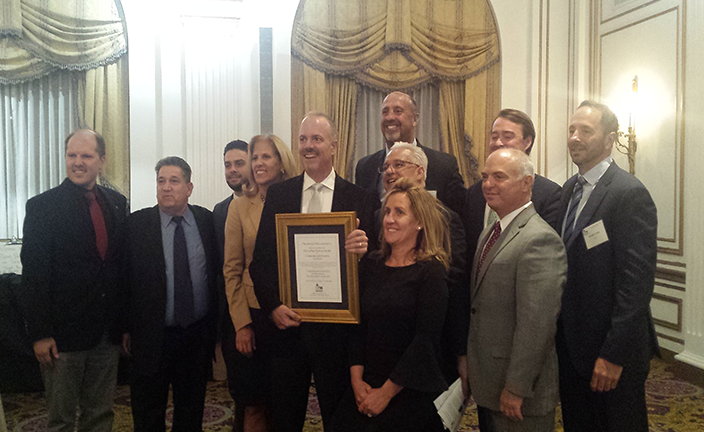
Commonwealth Landing Team Photo 17-051020170510_211219_klst
Preservation Massachusetts awarded a Paul and Nikki Tsongas Award in the category Best Building Programming to Commonwealth Landing, a mixed-use development located in Fall River, Massachusetts.

Commonwealth Landing, one of the former Quaker Fabric Corp. mills, is located on Davol Street in Fall River Massachusetts. The owners and development team of Tony Cordeiro, Larry Couto and Alan Macomber envisioned the mill as the center of new development along the Taunton River. Now, the first and second floors are now occupied by businesses and stores. The third, fourth and fifth floors of mill building were converted into 103 one, two and three-bedroom market rate apartments.

Congratulations to all team members on the recognition from Preservation Massachusetts!

Howard Hughes Medical Institute Laboratory

December 22nd, 2016

While creating highly specialized research facilities, LLB Architects implemented a strategy to employ common design principals and finishes throughout the complex to tie the incongruous renovations together and create a singular approach for the entire complex. One of the signature classrooms in the Bio-Med building at Brown University is the Howard Hughes Medical Institute Lab (HHMI). The design allows for students to learn hands on, with project based learning in the four corners of the room, taught from the center. This type of advanced learning environment is a key approach for laboratory design at LLB Architects.

Other highlights of the HHMI laboratory classroom design:

  • Inherent flexibility in lab’s design and furnishings
  • Centralized instructor
  • Integrated technologies and utilities
  • Demonstration areas
  • Student surfaces and furniture which promote collaboration/non-hierarchical student workstation arrangements

Harvard Business School Arthur Rock Center

December 22nd, 2016

The Arthur Rock Center for Entrepreneurship at the Harvard Business School supports HBS faculty and their research in the field of entrepreneurial management and seeks to galvanize the business community with the energy and spirit of ‘what’s next.’ The Center offers a community of support, access to content that inspires and informs, and a gateway to entrepreneurial ecosystems everywhere.

LLB worked closely with the Business School and the Rock Center community to renovate an under utilized formal conference space adjacent to the Director’s office into a new open workspace that encourages gathering and collaboration. The flexible spaces allow for group study and discussion while the break-out space provides students with a place to touch-down while at the Center. This area of the Center is meant to encourage face-to-face interaction and discussion while offering the technological tools groups may need for study.