Commonwealth Landing Receives a Tsongas Award

May 11th, 2017

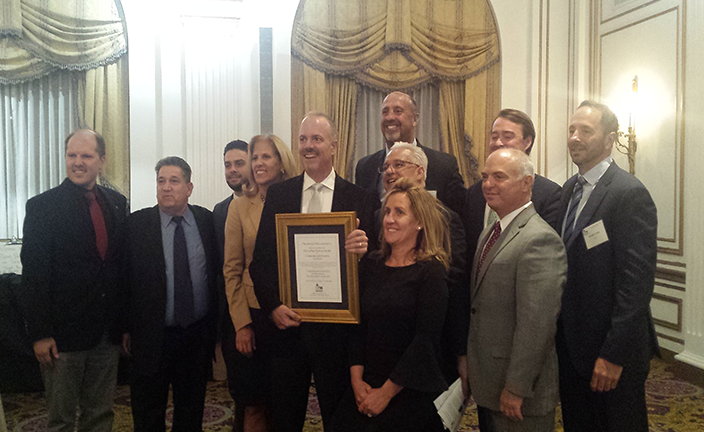
Commonwealth Landing Team Photo 17-051020170510_211219_klst
Preservation Massachusetts awarded a Paul and Nikki Tsongas Award in the category Best Building Programming to Commonwealth Landing, a mixed-use development located in Fall River, Massachusetts.

Commonwealth Landing, one of the former Quaker Fabric Corp. mills, is located on Davol Street in Fall River Massachusetts. The owners and development team of Tony Cordeiro, Larry Couto and Alan Macomber envisioned the mill as the center of new development along the Taunton River. Now, the first and second floors are now occupied by businesses and stores. The third, fourth and fifth floors of mill building were converted into 103 one, two and three-bedroom market rate apartments.

Congratulations to all team members on the recognition from Preservation Massachusetts!

Howard Hughes Medical Institute Laboratory

December 22nd, 2016

While creating highly specialized research facilities, LLB Architects implemented a strategy to employ common design principals and finishes throughout the complex to tie the incongruous renovations together and create a singular approach for the entire complex. One of the signature classrooms in the Bio-Med building at Brown University is the Howard Hughes Medical Institute Lab (HHMI). The design allows for students to learn hands on, with project based learning in the four corners of the room, taught from the center. This type of advanced learning environment is a key approach for laboratory design at LLB Architects.

Other highlights of the HHMI laboratory classroom design:

  • Inherent flexibility in lab’s design and furnishings
  • Centralized instructor
  • Integrated technologies and utilities
  • Demonstration areas
  • Student surfaces and furniture which promote collaboration/non-hierarchical student workstation arrangements

Harvard Business School Arthur Rock Center

December 22nd, 2016

The Arthur Rock Center for Entrepreneurship at the Harvard Business School supports HBS faculty and their research in the field of entrepreneurial management and seeks to galvanize the business community with the energy and spirit of ‘what’s next.’ The Center offers a community of support, access to content that inspires and informs, and a gateway to entrepreneurial ecosystems everywhere.

LLB worked closely with the Business School and the Rock Center community to renovate an under utilized formal conference space adjacent to the Director’s office into a new open workspace that encourages gathering and collaboration. The flexible spaces allow for group study and discussion while the break-out space provides students with a place to touch-down while at the Center. This area of the Center is meant to encourage face-to-face interaction and discussion while offering the technological tools groups may need for study.

Harvard Business School Wilder House

December 22nd, 2016

LLB Architects has worked with Harvard Business School for several years on the renovation and upgrades to some of the School’s buildings. In the Fall of 2013, LLB was asked to study, evaluate and assess the historic Wilder House in order to make the building ADA compliant in a manner that offered disabled students the same facilities and amenities as the rest of the student body. The project included the renovation of the first floor to include accessible entries, work stations, and conference rooms; interior renovations to the rest of the house included the re-configuration of spaces to accommodate displaced staff from the first floor.

On the exterior, the renovations and restorations focused on simple placemaking gestures. The areas of primary focus included window replacement, re-pointing the brick, and significant restoration to the wood trim details.

Bryant University Physician Assistant Learning Center

December 22nd, 2016

Bryant University sought to establish a School of Health Sciences that would be anchored by its graduate Physician Assistant Degree. The degree is one of the fastest growing majors in the country and Bryant is bringing a rigorous and supportive program to prepare their physician assistant students to meet the needs of the health care system. The degree supplements an already offered Master in Business Administration degree with a concentration in health care. Bryant’s largest academic building, the Unistructure, was selected for an addition to house the program.

LLB Architects designed the space working with Lavallee Brensinger Architects, specialists in healthcare design, to accommodate the program’s unique needs. We worked with the University to generate program overlays within the existing building spaces, creating an inherently sustainable mix of reduced new construction with selective renovation. The public space was designed to capture the great views of the campus while allowing for an abundance of natural light. The classrooms and laboratories are designed to facilitate the successful transition from classroom to physician’s office. The new addition includes both lecture and team-learning style classrooms, a high-fidelity simulation laboratory, and a realistic physical examination laboratory. The transparent facade showcases the bustling activity within the building and includes a grand staircase and a lounge area offset by walls of glass and brick.

Photography by Warren Jagger

Brown University Herbarium

December 22nd, 2016

This renovation for Brown University’s Herbarium relocated it from the basement of Arnold Laboratories — a small space designated as “temporary” in 1987, to the second floor of the Bio-Med Center. The 1,600 sf space is large enough to house the current collection, collections from across the campus, and from various conservation groups in Rhode Island, while maintaining space for future collections. The move restored the Herbarium to a place of active research and digitization of the specimens it houses.

The major design challenge for the Herbarium renovation was combining function with an architectural aesthetic that promotes public connectivity to one of the area’s oldest collections of preserved plant species; and doing so within a restricted budget. The program includes a preparation room for cleaning and disinfecting specimens; sorting and processing room for studying, cataloging and preserving specimens; conditioned collections room for housing relocated plant specimens; and administrative support space.

Working closely with Brown University, LLB was able to arrange the program spaces in a manner that allows
proper sequencing for prepping, studying, and collecting specimens without contamination from the outside environment while also providing visual connectivity to the public. This project is a prime example of LLB Architects’ ability to work closely with clients to provide an integrated design the combines function with architectural aesthetic.

RISD Teaching and Learning in Art & Design

December 21st, 2016

The TLAD program requirements included a space for masters candidates to work both independently and collaboratively with easy access to advising faculty, space for visiting lecturers, and seminar classes.

LLB architects were challenged by the dark, low ceilings, and warren-like existing office space. The successful renovation is rooted in a highly efficient, flexible layout made vibrant by maximizing perceptions of space and borrowed light. The entry/waiting area subtly brands the space and has inviting site lines to offices, conference room, and a collaborative learning space beyond. Right sized faculty and administration offices with glass storefront entries provide their occupants a sense of connection and privacy.

Strategically located gallery wall panels energize passage through the space and partition the multi-function conference room.

Oversized doors allow the conference room to be closed for private meetings and seminar classes or to be opened as an extension of the collaborative learning space.
The collaborative learning space is clear and open with modular lounge furniture, tables and chairs allowing for a broad range of configurations. The space is used for quiet study, small and large group projects, lectures and gatherings.

Furniture was replaced by the client with large custom made tables and stools on casters.

These changes transformed the ground level adapted commercial storefront space to a purpose built studio environment suitable, flexible, and comfortable for its many uses.

RISD Graphic Design Gallery

December 21st, 2016

RISD’s Graphic Design Department was seeking to develop a common, multi-use space that would allow the department to host various shows, events, and gatherings. The first floor of the building that houses the Graphic Design Department provided the location they were looking for. In developing a plan for the floor, the administrative offices were moved to locations that allowed for improved coordination and better temperature control. The gallery space occupies a central location.

The administrative offices make highly efficient use of space. They are partitioned at the back of the larger gallery by a bright yellow wall skewed to be orthagonal with the exterior and making the interior a bit more generous for the occupants. A frame less storefront system give these modest offices a strong connection to the outdoors and community connection.

The GD Gallery plan was reduced to the essentials and it was constructed with honest durable materials. It is designed for work and viewing, not to draw attention to the architecture. Where design elements are required, LLB steered clear of commercial solutions and instead, prepared the space to accept uniquely RISD constructions.

Franklin Public Library Ground Breaking

December 16th, 2016

June 3, 2016 – The Franklin Public Library, established in 1790, is widely considered to be the nation’s first public library. The library collection was started with the donation of 116 books from Benjamin Franklin. The current library was built in 1904 and added onto in 1989. Faced with the need to make internal improvements and a shortage of the space needed to accommodate a record number of library visitors resulting from a surge in the Town’s population, the decision was made to move forward with the recommendations of a previously completed study.

LLB Architects, hired to design the historic restoration, renovation, and 6,000 square foot addition to existing 22,000 square foot building, worked closely with the library, town and community to develop a solution that would meet their goals. The project will increase the capacity of the general stacks, provide much needed meeting and community rooms, increase the size of the children’s room, and create a young adult room. Additionally, the building’s heating, air conditioning and sprinkler systems will be updated.

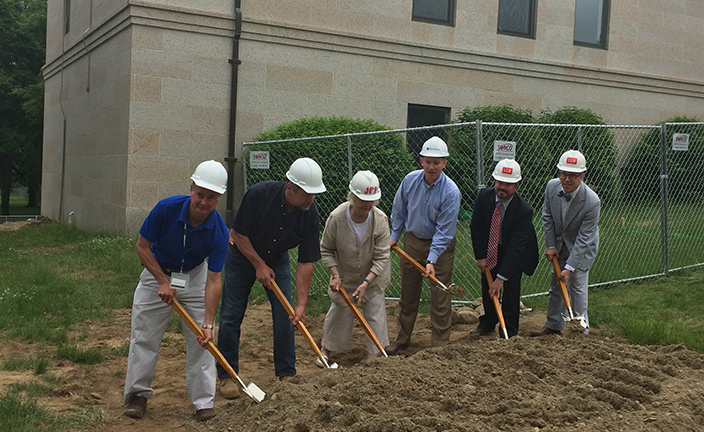
The ground breaking ceremony held today was the celebration of the start of a long anticipated project within the Town of Franklin.franklin-library-ground-breaking

Peter Green House at Brown University

December 16th, 2016

The Peter Green House at Brown University was much more than a simple renovation project. To make way for the University’s “The Walk” Project, the 1890 historic wood-framed house was painstakingly uprooted and moved away from its original foundation. Its strategic relocation to the corner of Brown and Angell Streets maintains the mixed use character of the neighborhood, with residential scale and university buildings side-by-side.

The Peter Green House previously housed the Department of History, and continues to do so in its new location. In addition to full restoration, Brown University sought to upgrade the building significantly, with a new ADA-accessible lower level, a LULA lift to the public spaces, new sprinkler system, new fire alarm system, and improved egress stairs. All but one exterior fire escape have been removed, restoring the building to its original character.

Video: Peter Green House Move >>