Acton Town Facilities Assessment

May 27th, 2024

LLB Architects was hired by the Town of Acton to conduct a Town-wide assessment of their buildings. The project objective was to provide a database and methodology that used a uniform rating system and independent cost projections, allowing the Town to improve how it plans for work at its facilities. After our assessment team completed a document review for the 19 buildings, we visited the structures to identify and observe systems, assemblies, and components for each and note any deficiencies.

We determined the quantities and costs necessary to remedy the deficiencies to develop an order of magnitude estimate for deferred maintenance items. Our team then compared these estimates relative to each other using a facility condition index, which provides an objective level of severity of deficiencies per building by removing the size and significance from the comparison. All of the data collected during the study was stored and processed in a database, which we delivered to the Town. The database allows the Town to organize, filter, and present the information in numerous ways, providing an option for both broad analyses and detailed reporting. Additionally, the database may be continuously updated to rapidly recreate future studies.

Nantucket Town Facilities Assessment

May 27th, 2024

LLB Architects was retained by the Town of Nantucket to conduct a town-wide facilities study to better understand necessary actions to keep their buildings in an appropriate condition for public investment. The primary objective of the study was to provide a database and methodology by which the Town would be able to develop better plans for work at its facilities through a uniform rating system and independent cost projections.

The study encompassed the survey and documentation of the condition of 24 buildings owned by the Town. The analysis included the individual components of the building, systems that were fundamental to the operation of the building, and the building as a whole. The analysis also uncovered areas of common concern. The assessment provided a baseline across the different construction types and ages of the building for budgeting and scheduling repairs. The information from the study informed discussions the Town had regarding the viability or appropriateness of a specific building for a particular use.

The study allowed the Town of Nantucket to develop more accurate forecasts for the fiscal and physical needs of their facilities stock for the next 20 years.

New Community Preparatory School Arts & Athletic Center Opens

May 14th, 2024

LLB Architects joined Community Preparatory School for a dual celebration of the school’s 40th anniversary and the opening of its new Arts and Athletic Center on Thursday, May 9th. The new building provides a gymnasium, arts facilities, and a much-needed community space for the school. The Cheers to 40 Years celebration was a perfect opportunity to inaugurate the new space!

Serving as a multi-purpose gathering space for Community Preparatory School’s full network of students, teachers and families, the new Arts and Athletic Center features indoor basketball and volleyball courts, an art gallery and display walls, performance and backstage production area, along with extensive storage space. The gymnasium can also be used for seating for up to 240 people together at circular tables for meetings or meals.

LLB has had a longstanding relationship with Community Preparatory School, an independent school for grades 4-8 in Providence that serves culturally and economically diverse students who benefit from a rigorous academic education in an atmosphere of mutual respect. Working with the school since 2005, LLB has supported the expansion of the campus through master planning, assistance with the purchase and closure of Somerset Street to create a playing field, an addition to their existing building and now a new Arts and Athletic Center.

R. Drayton Fair Retires After 21 Years with LLB Architects

April 17th, 2024

LLB Architects announced that R. Drayton Fair, AIA, ALA, LEED AP retired at the end of April 2024 following more than 20 years of leading the firm’s municipal and library practice. Drayton has contributed significantly both to LLB Architects’ growth as a leader in the design of public buildings as well as its overall expansion with the opening of a second office in Worcester, MA in 2018. While Drayton will retire from LLB, he will continue in an advisory role and support the firm’s work through his longstanding relationships in the library and municipal sectors.

After receiving his Bachelor of Fine Arts and Bachelor of Architecture from the Rhode Island School of Design, Drayton built an extensive portfolio of work in the public sector, including a special focus on library design. Upon joining LLB in 2003, Drayton became a Principal and later Senior Principal and helped shape the future of the firm as it grew from a well-respected Rhode Island firm to a regional design leader.

Drayton’s legacy includes more than 40 library projects and numerous municipal projects completed while at LLB, including notable work at Acton Town Hall, Bolton Public Library, Boyden Library, Cranston Public Library, Foxborough Town Hall, Franklin Public Library, Marlborough Public Library, Maynard Public Library, Newton Free Library, North Scituate Public Library, Putnam Municipal Building, Watertown Free Public Library and Worcester Public Library. Current projects at the Sharon Public Library and Littleton Senior Center are under construction. Drayton’s work includes a focus on historic preservation and designing modern additions to complement historic libraries.

As a recognized expert in the planning and design of library and municipal facilities, Drayton has taught and spoken at universities and conferences throughout New England. These include the Boston Society of Architects, Harvard University, New England Library Association, Rhode Island School of Design, and recently Roger Williams University. He served as the President of both AIA Rhode Island and AIA New England. Drayton is an active member of the National Trust for Historic Preservation, the American Library Association, and the U.S. Green Building Council. He currently serves on the Cranston Public Library Board of Trustees and the Rhode Island Board of Examination & Registration of Architects.

Brian Valentine, AIA, LEED AP, who joined LLB Architects in 2014 and was named a Principal in 2021, has worked with Drayton on numerous library and municipal projects. “During my 10 years at LLB, Drayton and I collaborated on multiple projects. He is focused on designing spaces that reflect the story of each community and inspire learning and exploration. From historic reading rooms to playful children’s spaces, Drayton sees an opportunity to inject creativity and life into each project.” Brian and Drayton worked on major renovation and addition projects at Franklin Public Library, Marlborough Public Library and Worcester Public Library.

LLB Architects, which celebrates 88 years in business this year, is led by Senior Principals Christian J. Ladds, AIA, LEED AP and Kathleen A. Bartels, AIA LEED AP. They are joined by four Principals who represent the firm’s next generation of leaders: Suzanne DiSalvo, Associate AIA, LEED AP; Enno Fritsch, Associate AIA, LEED AP; Jonathan M. Taylor, AIA, LEED AP; and Brian L. Valentine, AIA, LEED AP.

South Kingstown Housing Authority Facilities Assessment

March 27th, 2024

LLB Architects conducted a tailored facility condition assessment for the South Kingstown Housing Authority. We focused our inventory method on the housing assets and their renewal needs to suit the next steps for the Housing Authority. Our assessment team produced a short-term capital renewal outlook based on each facility’s current physical state, centered on life cycle, deferred maintenance, life safety, and accessibility observations and analysis. This report provided a baseline to then inform repositioning opportunities under HUD’s Section 18 process for Demolition/Disposition.

The South Kingstown Housing Authority (SKHA) manages three housing developments: Fournier Estates, Champagne Heights, and Village Gardens. The Fournier Estates and Champagne Heights properties have not undertaken any significant modernization or improvements in their 35+ year life span, and maintenance has been primarily reactive in nature. Village Gardens is about 25 years old, but shows modest signs of deferred or neglected maintenance.

Marlborough Public Library

January 19th, 2024

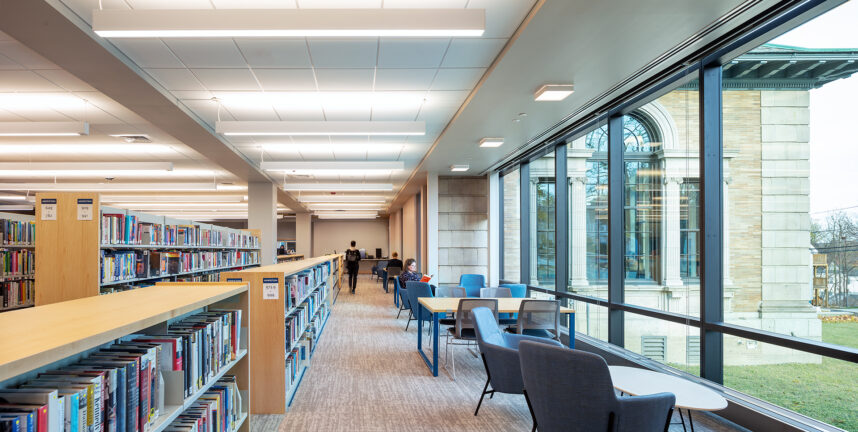
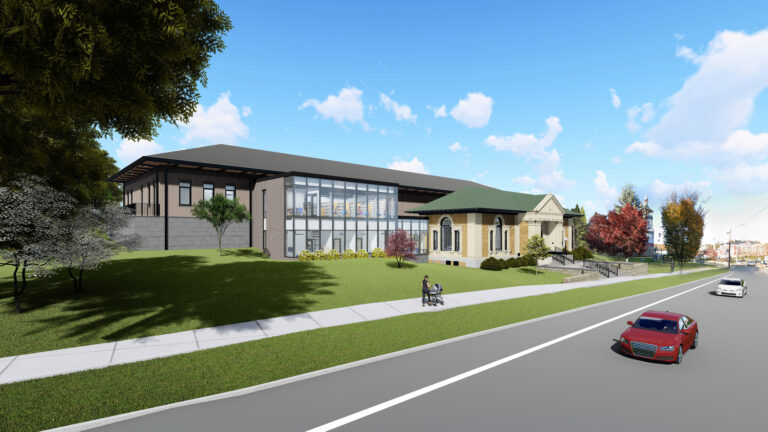
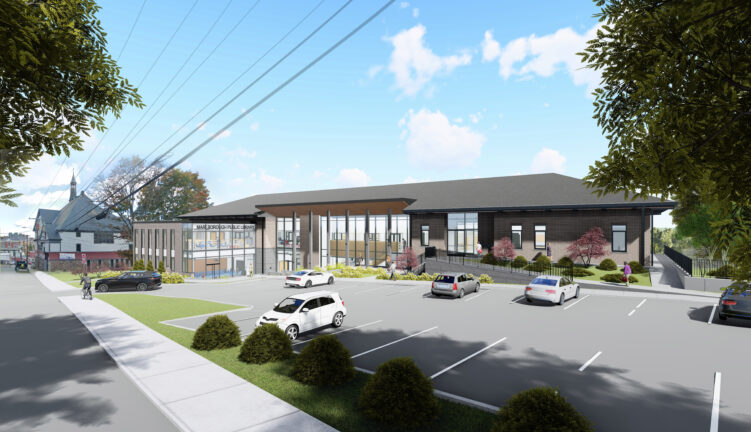
LLB Architects worked closely with the library director and Board of Trustees to determine the best path forward, including the incorporation of the historic Carnegie library’s facade into our new design. After we conducted the necessary feasibility study, the Town completed the Massachusetts Board of Library Commissioners’ grant process and was subsequently selected to receive funding.

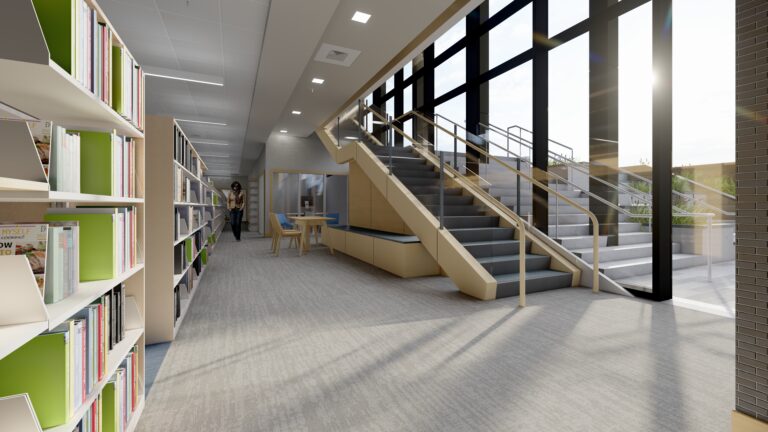
Our design for the renovation and new addition includes a Local History Room and a spacious room for meetings or activities with a catering kitchen. Rooms to address staff needs, such as break and training rooms are located in the lower level, as well as large areas designated for storage. On the main level, the Adult Collections, Young Adult Collections, several study rooms, and a cafe will draw patrons through the Carnegie facade and into the new addition.

On the upper level, the staff offices were refreshed and have updated programming. An expanded Children’s Area, including a large program room and Children’s Staff Workroom and Offices, makes up a large portion of the level. Group study rooms and staff meeting spaces are also located on the upper level.

Rhode Island College – Horace Mann Hall

January 19th, 2024

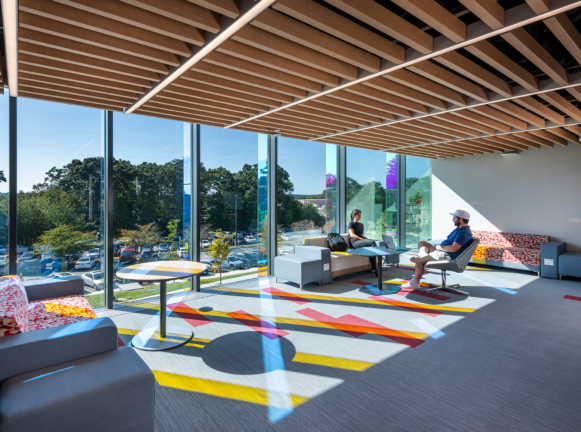
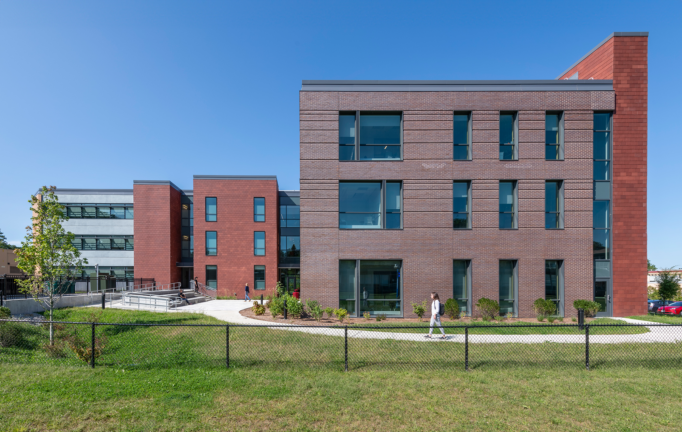
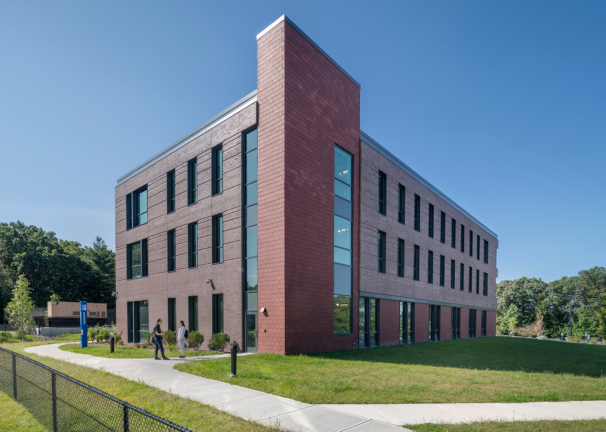
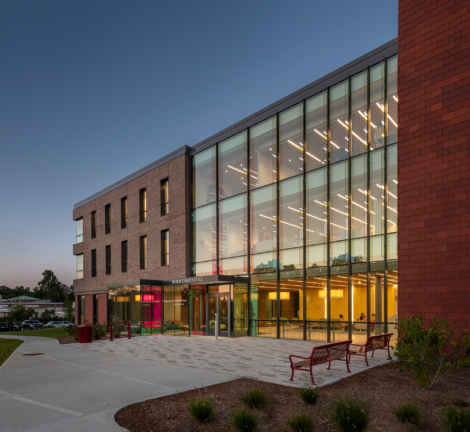
Built in 1969, Horace Mann Hall lacked daylight, faced accessibility issues and had a fragmented footprint. In short, the existing building was poorly suited to serve as a beacon for the Feinstein School of Education and their mission to provide innovative and collaborative educational excellence. Initially envisioned strictly as a renovation, LLB was able to demonstrate that demolition of part of the existing building and the construction of a new wing would provide a better outcome while sticking to the original budget. The renovation/addition option provided an opportunity to reimagine the space, including creating a light-filled central commons and compact three-story office wing. The reduced footprint is more energy efficient and allows for new green space around the building and improved connections to the campus.

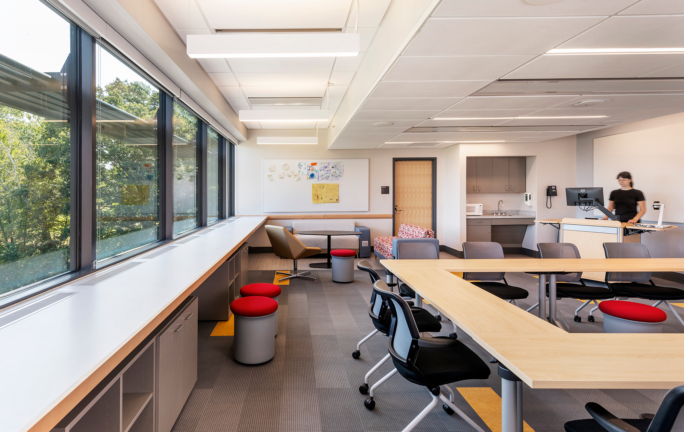
The renovation of Horace Mann transformed the building to align with the school’s role as a leading institution for training future educators. The building exterior reflects the school’s role as a beacon of education with its dynamic color-changing glass fins coated with dichroic glazing which reflects the sunlight. The design creates a dedicated section for faculty suites and provides necessary acoustical and visual privacy for this area of the building. Within the classroom wing, cutting-edge simulation spaces provide students with a realistic learning environment and help hone their professional skills. The welcoming commons between the renovated classroom wing and the new offices suites engages with the campus and brings views and daylight deep into the building. The building was designed to meet LEED Gold standards and is currently pursuing certification.

Read a review of the building by its faculty, staff and students.

The Creative Class

November 3rd, 2023

The Creative Class is a modern apartment community housed in the prior Bradford Durfee Textile School in Fall River, MA. Built in 1904, the school operated in this location until the mid 1960s when it relocated to North Dartmouth. LLB Architects worked with the developer to adaptively reuse the buildings for modern residences while retaining historic materials and the character which draws residents to them. There are 55 units across the three buildings, including 11 artist preference studios, 14 one-bedrooms, 29 two-bedrooms, and 1 three-bedroom. The Creative Class offers both market rate and affordable apartments.

LLB worked with the developer and a historic preservation consultant to assist the developer in successfully attaining federal and state historic tax credits. This is the second large-scale residential conversion project which LLB has completed with the developer.

Commonwealth Landing

July 7th, 2023

Commonwealth Landing is a renovated mill building in downtown Fall River. With active commercial space on the first two floors, the developers opted to transform the top three floors of the building into residential units. Included in the project are 103 one-, two-, and three-bedroom units, a fitness room, a small recreation room with a pool table, and a community room with a kitchenette for gatherings.

The building already hosts numerous retail establishments, restaurants, galleries, and offices. With a strong demand for rental units in Fall River, the addition of the Commonwealth Landing apartments has provided the opportunity for a much needed boost to the local economy.

The developer team received both federal and state historic tax credits, along with a state tax credit for building market-rate housing in a Gateway City. Our firm worked closely with the developer on the design and construction of the units and assisted the client with the tax credit application.

Arctic Mill Study

July 6th, 2023

The Arctic Mill Complex on Factory Street in West Warwick includes two granite buildings along the South Branch of the Pawtuxet River. The complex is a large, L-shaped stone mill located along the east side of the river. The main block, perpendicular to Factory Street, is a 5-story structure, with an 8 story flat roofed square tower centered on the east side. Working closely with the developer, LLB Architects developed a design to renovate this historic mill into a new residential community featuring 138 units, including studio, one- and two-bedroom units.

In 1865, a fire caused extensive damage to the original mill and its contents, but the walls were used in rebuilding the mill. Renovations made in 1884 included changes to the roof and the addition of another story on the main mill. On the interior, the mill is a open factory space with a regular grid of columns supporting heavy beams. On several levels the space has been subdivided with modular storage units as well as small office and mechanical rooms.

In addition to planning and architectural design, LLB assisted its client in preparing the application for historic tax credits for the project. We also assisted in developing a working pro forma for the project.