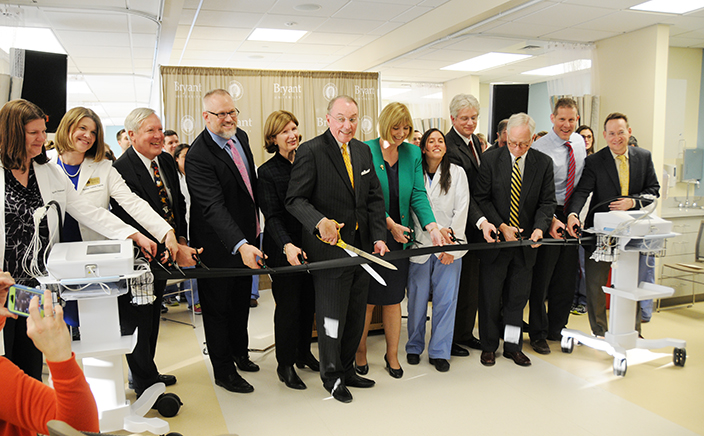
Bryant University’s Physician Assistant Learning Center Holds Ribbon Cutting

May 11th, 2015

DSC_7116

April 8, 2015 – Bryant University’s new Physician Assistant Learning Center held its Ribbon Cutting and Grand Opening ceremony on March 2nd in the facility. The event featured speeches from Bryant’s President Ronald K. Machtley (center) and Jay Amrien (3rd from left) the Director of the Physician Assistant Program. Chris Ladds (4th from right), Kathy Bartels, and Jonathan Taylor attended the event on LLB’s behalf to celebrate the opening.

LLB designed the space working with Lavalle Brensinger Architects, specialists in healthcare design, to accommodate the programs unique needs. Working collaboratively with the university to program, plan the building that includes simulation laboratories, lecture classrooms, and office for faculty and staff.

Boyden Library

March 16th, 2015

The existing Boyden Library in Foxborough, built from 1967-1968, is a surviving example of mid-century brutalist architecture. By its design and nature of untouched longevity, it is a beautifully honest representation of construction method and structural integrity, yet was in need of an expansion and reconfiguration. A renovation of the existing 20,000 square foot space included replacement of mechanical systems, roofing, windows, elevator, removal of all asbestos and addressing all handicap accessibility issues.

In keeping with the original form, the new addition remained in concrete, glass, and monolithic limestone. The horizontal and vertical geometry of structural components and windows also remained intact as a complement to the original design. The additional 13,800 square feet provides increased space for Boyden Library and its expanding collection of literary and media resources. More than 30 computers have been added for public use and an improved meeting room provides space for Foxborough’s community groups and organizations. The top floor is home to an inviting and sun-filled children’s department, now double the size of its previous square footage, and equipped with cozy furniture and colorful shelf paneling that changes with images of the New England season.

A glass-paneled staircase provides an intriguing experience for those accessing the first and second floors with expansive views of the outside. The largest area in the library is the reading room, which contains fiction, periodicals, and several computer stations. The mezzanine, or half-floor, contains the administrative offices, local history, and a café area. An art gallery outside the meeting room provides a place for local artists to share their art with the community.

The $11.6 million project was partially funded through a $3.6 million construction grant from the Massachusetts Board of Library Commissions and an additional $7.5 million of town-approved funding. Other funds came from a fundraising campaign and private funds which includes money from the library’s trust fund and donations.

Photography by Bruce T. Martin.

Hillside Hall at University of Rhode Island

March 10th, 2015

Acting as a gateway to the Hillside District, the new $42 million, 429-bed Hillside Hall by LLB Architects is a dynamic new model for residential housing at the University of Rhode Island. The 120,000 square-foot structure remains permeable at the ground level to enhance the cross–campus ties and pedestrian inter-connectivity while maintaining universal accessibility. Two bar-shaped wings are sited along the sloping hillside and connected by a glass bridge which houses stacked sky lounges and a monumental circulation stair. Light floods the interior and is animated with a rhythmic pattern of colored glass, creating a diverse array of shadows that constantly change.

The organizing principle of the design merges the two primary grids of the campus plan that are thoughtfully woven together to create unique cantilevers, ledges, and intersections. The two residential wings are cranked and cracked open to allow natural light into the double-loaded corridor which terminate with transparent glazing. These moments at the grid intersections become group and collaborative study lounges for the freshmen and sophomore student residents in pharmacy, nursing, and international programs, part of a Living and Learning Community. The configuration of bedroom clusters around these lounges promotes a sense of identity and community within the larger complex, reinforcing the social fabric of Hillside Hall within the residential district.

The most effective and economical methods to achieve a green building comes from a holistic approach to sustainability. LLB Architects integrated solar hot water system, exterior sun shading and sun screens, operable windows for maximized natural ventilation, light reflecting roofing materials with demonstration green roof, a rigorously designed and engineered building envelope with maximum insulation and materials chosen for high recycled content obtained regionally. All uphill water is captured in a series of rain gardens that collect and filter water through a sequence of above ground water retention basins. Permeable pavers, reflective site materials, and extensive new site plantings all contribute to a truly sustainable landscape. Certified as LEED Gold, the project set new standards for environmentally friendly residence hall construction.

This project was done in association with associate architect Mackey Mitchell Architects. Site plan and landscape design by Carol R. Johnson Associates. Photography by Paul Burk Photography and Warren Jagger Photography.

Thayer Homestead

February 28th, 2015

In 2013, the Town of Medway turned 300 years old. In preservation of that history, with a look to the future, the town selected LLB Architects to facilitate the restoration of and addition to the 150 year old Thayer Homestead, a historic farmhouse built in the 1830s for adaptive reuse for public and private functions.

In concert with an existing 2007 structural report, the historic home received historic improvements, structural upgrades; and complete MEP/FP systems. The homestead addition primarily consists of one large double-height exposed timber framed banquet space, with glazing on two exterior sides, connected to a new patio that overlooks a large grass field, Choate Park and pond, and a lovely 54” diameter beech tree. In the midpoint of the long exterior façade is a double-sided fireplace within a stone chimney, which faces both the banquet and patio spaces. One story service areas, such as a caterer’s kitchen, and restrooms, connects to the banquet space on its other two sides.

The addition and the public portion of the homestead is accessed from a new entry vestibule situated at the intersection of both buildings. The addition is set back from the homestead which retains its prominence, and the addition only touches the homestead on a rear corner, below its roofline. The vestibule walls are mostly glass, allowing visitors on arrival, to look forward through the building to the view of the park and pond beyond. LLB Architects initial impression of the site and landscape was of a directional view across the landscape and the pond. The design reinforces this natural view, creating a new space that complements it context, harmoniously retains forward and outward views to its site, while honoring its adjacent past.

Read the latest from Wicked Local on the project nearing completion.

RISD Apparel Design Department

February 16th, 2015

LLB Architects worked with Rhode Island School of Design (RISD) on the study, design, and renovation of a downtown Providence turn-of-the-century building to serve as the new home for their Apparel Design Department.

The existing office building was converted into large, well-lit, open, and technologically advanced studio spaces and classrooms which enhance and promote the hands-on learning environment of the department.

A flexible multi-purpose space is used as separate classrooms as well as a single large studio space to hold departmental semester critiques by moving tackable and mirrored portable wall partitions. Large glazed openings into the studios and display cases in the corridors exhibit the students’ progress and projects throughout the school year. A welcoming faculty suite with collaborative office/workspace and a conference room greets visitors as they arrive in the building as a space to house the high-level fashion and designer materials that teachers often share with current and prospective students.

Click the link below to see RISD’s Film “Welcome Home” celebrating the new facility:

http://our.risd.edu/post/100077066529/welcome-home

Harvard Business School Knowledge and Library Services

June 25th, 2014

At Harvard Business School, the historic Baker Library’s Department of Knowledge and Library Services needed a space to meet their growth and changing business model. The department employs transient professionals as well as full time staff who juggle a combination of contemplative and collaborative workloads. LLB designed the space within Baker Library for their department conscientious of their need for both permanent and flexible spaces. The only dividing walls were envisioned as glass curtains with enlivened obscuring graphics, loosely designating zones of activities without imposing the bulk of typical plaster walls. Workstation wall heights were designed as low and permeable, featuring solid zones where privacy was most needed. Workstation size was designed as minimal, offering nearby closeting for background binders and bulk of more permanent employees. Clusters of workstations were served by adjacent break out collaborative zones accommodating groups of 2-5 personnel. These zones featured mobile furnishings and writing and posting wall space. Large meetings were accommodated in a new open conference and meeting zone that was furnished specifically to their webinar meeting style. The solution broke down the traditional boundaries of the cubicle and integrated collaborative zones throughout to give this group infinite flexibility.

Gender & Sexuality Center at the University of Rhode Island

August 23rd, 2013

The Gender & Sexuality Center at the University of Rhode Island (URI) is the first of its kind in the United States.
The project included the demolition of the 4,000 sf Ruggles House and the design and construction of a two-story wood structure of approximately 5,000 sf. The program spaces include multipurpose rooms, a student lounge and resource area, a kitchen, and office space. The site development also included parking and landscaping.

The design of the G&SC at URI is inspired by themes found in history and daily LGBTQ life. The stone facade on one volume of the building represents the strength and permanence of diversity while recognizing the 1968 Stonewall Riot in Greenwich Village. The pergola over the front entrance is representative of how often the community has had to be hidden. As a celebration of acceptance, the pergola is now a safe and open presence welcoming visitors to the Center.

Landscape plan by Birchwood Design Group

Clock Tower Residence

August 8th, 2013

LLB Architects was hired by ID Holdings to explore the development of a 2.3 acre site on George Street in Pawtucket that is occupied by the former St. Mary’s School and Convent. Both historic existing buildings date back to the 1890s. All efforts will be made to preserve and protect these richly detailed structures. As a contrast, the new building is designed to be a more modern looking building with a “light” feeling exterior rainscreen envelope. The connection from the old building to the new is achieved through an irregular and vibrant glass box. Together these elements form an open courtyard space that will include a terraced rain garden.

LLB successfully developed the project and shepherded it though city planning and zoning process. The approved project is scheduled to comprise 132 units containing a mix of unit types: 9 Studios, 66 One Bedroom Units, 53 Two Bedroom Units, and 2 Two Bedroom + Den Units. Careful consideration was made to integrate 194 parking spaces onto the site. Several spaces are slated to occur under the new building footprint to minimize their visual impact on the site.

The Zoning Board unanimously granted the 10 requested variances. The city planner noted at the hearing that they were supportive of the project and that it was very “high quality.” He also indicated that LLB had worked effectively with the city and neighborhood at accommodating requests and comments throughout the process.

Ideation Lab at Bryant University

July 2nd, 2013

The Ideation Lab is a pilot project investigating new teaching modalities at Bryant University. An innovative layout combined with flexible furniture and collaborative work surfaces have made this project a new model for forward-thinking educational practices, encouraging new types of interactions between learners and educators.

Working collaboratively with Bryant University educators, LLB Architects designed this learning environment to foster collaboration between students and between students and educators. As a room oriented “in-the-round,” the classroom features writable surfaces on all walls. Rather than lecturing from the front of the classroom, the educator is free to navigate through the room, and easily able to engage with students to guide discussion or present ideas.

LLB Architects

February 19th, 2013

LLB Architects, formerly Lerner Ladds + Bartels, is a leader in designing timeless environments that allow people to thrive. The architectural practice is built upon the core values of care for the environment, communities and clients. A multi-disciplinary firm, LLB has a wide portfolio of work for both public and private clients. Since its founding in 1936, LLB’s success has been rooted in its ability to collaborate, explore and (re-)invent using an approach that integrates people and technology. Learn more…

We are always looking for talented designers and architects! Learn more about career opportunities and how to join our team.